


Before becoming an early childhood educator, Jessica Herbert hadn’t pictured herself building a career working with children.
She was raising three young children, caring for her younger brother and spending much of her life focused on her family. She wanted a career and a sense of direction but wasn’t convinced she was capable of taking that next step.
“I was a mother of three, thinking that I couldn’t do it,” Jessica said.
“I lived in the four walls at home. To be honest, I didn’t believe I was good enough.”
Fast forward to today, Jessica has completed her Certificate III in Early Childhood Education and Care through Selmar Institute of Education, is continuing into the Diploma and works full-time as an assistant educator at Futuro Early Learning.
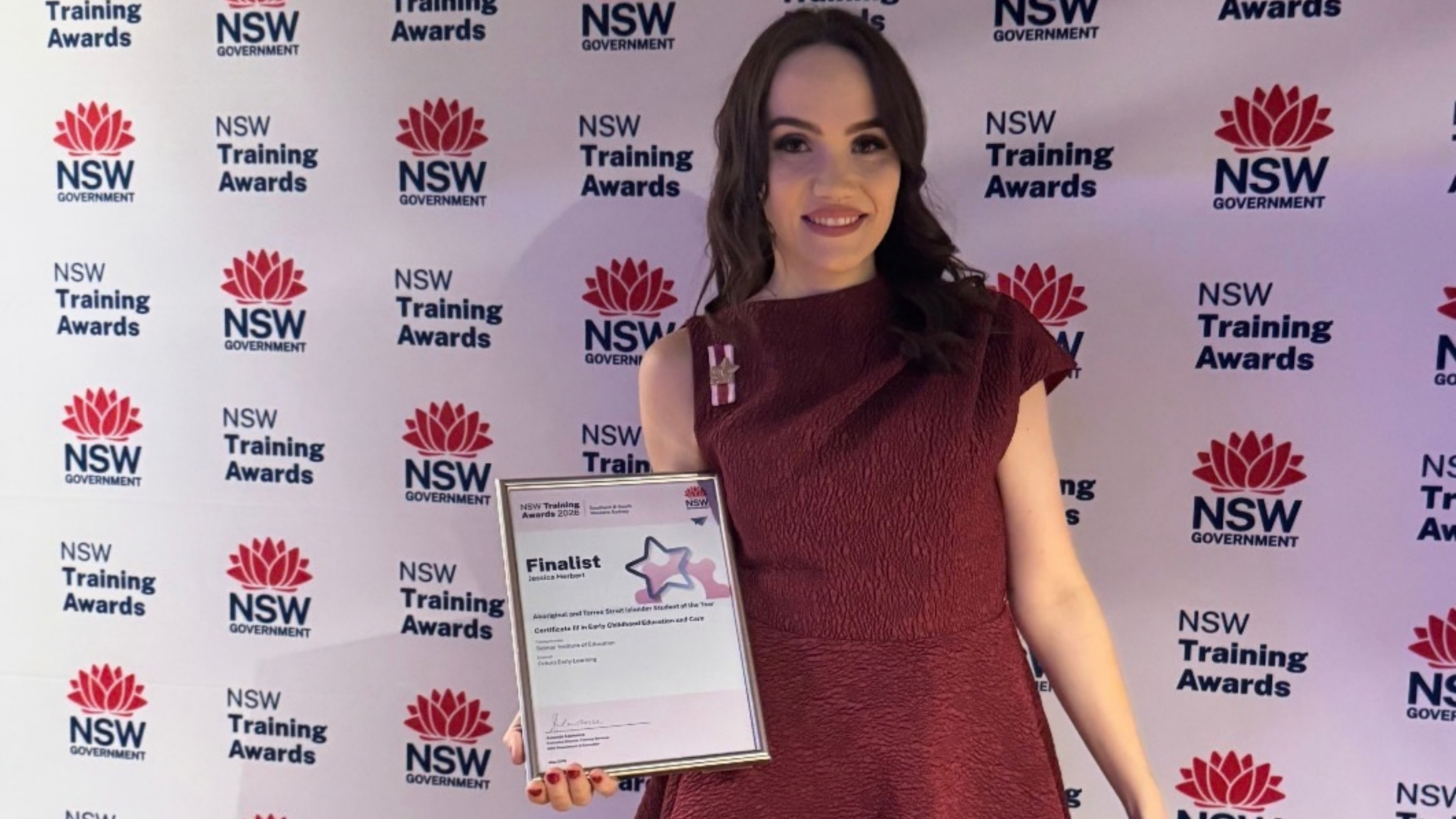
She was also recognised as a finalist in the Aboriginal and Torres Strait Islander Student of the Year category at the 2026 NSW Training Awards for the Southern and South Western Sydney Region.
It is a journey that began with her own children and has grown into a passion for meaningful learning, cultural inclusion and helping children and families feel understood.
An early childhood education career inspired by her own children
Jessica’s initial interest in early childhood education developed as she watched her own children learn and grow.
“It all started when I was raising my three children and I realised I wanted a career where I could make a real difference,” she said.
“My children inspired me to work in early childhood because I saw how important those early years were. I wanted to support not only my children, but other children and make a difference.”
The turning point came when Jessica watched her son begin kindergarten. Seeing him reach that milestone filled her with pride and helped her recognise how much she valued being part of children’s learning and development.
Before motherhood, it was not a career she had considered.
“Before having children, I’d never really seen myself working in early childhood,” she said. “It wasn’t something that I had planned.”
Once Jessica made the decision, however, she did not wait for an opportunity to find her. She began calling early learning services herself.
“I was like, ‘Hey, are you looking for someone? I don’t have experience,’” she recalled.
One centre was willing to give her that opportunity, and her new career began.
Learning on the job and finding her confidence
Workplace-based training gave Jessica the opportunity to learn while applying her new skills directly within the centre.
“This was my first time actually studying while being a mum and working,” she said.
Her workplace provided dedicated study time, while her partner stepped in at home whenever she needed extra time to complete a unit. Together, that support helped Jessica keep most of her study within work hours, so she could still come home and be present with her family.
She completed her Certificate III early and soon progressed into the Diploma of Early Childhood Education and Care.
There were still moments when balancing full-time work, study and family felt overwhelming.
“I questioned whether I could keep up,” Jessica said.
“But I reminded myself that I had to keep going. My children are the ones I’m doing this for. It’s not just for myself.”
Jessica also credited the support she received through Selmar, particularly from her assessor, Komal, with helping her continue progressing.
“I could not thank her enough,” Jessica said. “She was always willing to help.”
“Someone was always reaching out and checking in: ‘How are you going?’”
Before discovering the support available through workplace-based training, Jessica said she may have dismissed her career goal as something beyond her reach.
“I would have kind of just given up and thought, ‘No, I’m not good enough. I’ll leave it,’” she said.
“But I had all that support behind me. I am where I am today because of it.”
Turning lived experience into professional strength
Becoming an educator allowed Jessica to bring her natural care for children and families into the workplace. Her training helped her understand the professional knowledge and intention behind quality early childhood education.
“I’ve learned how to reflect, to observe and plan activities,” she said. “I’ve learned how to put meaningful experiences out there for the children.”
That knowledge has also changed how Jessica supports her own children at home. Something as simple as her daughter’s interest in butterflies can now become an opportunity to explore their wings, life cycles and natural environment.
Her experience as a mother also shapes the relationships she builds with families at the centre.
Jessica understands how difficult it can be to balance family, work and everything else life demands. She notices the relief on parents’ faces when they arrive feeling stressed and see their children run happily towards their educators.
She also draws on her experience parenting a child with global developmental delay and ADHD when families come to her with concerns about their own child’s development.
“Being able to sit with a parent and have a conversation that’s deep and personal on their level and letting them walk out with a smile on their face when they’ve come in a broken mess – it brings me joy,” she said.
For Jessica, her experiences as a mother were never something she had to work around to become an educator. They became one of her greatest professional strengths.
Creating culture, identity and belonging
As an Aboriginal and Torres Strait Islander woman, Jessica’s cultural identity is an important part of the educator she is becoming.
Through her previous role as Creative Ambassador, she helped educators develop engaging, age-appropriate learning experiences across different rooms and age groups.
The role allowed her to contribute beyond her everyday responsibilities, share ideas with colleagues and grow in confidence.
It also gave her a practical way to bring culture into children’s learning. Rather than presenting Aboriginal symbols or art activities without context, Jessica sits with the children, explains their meaning and encourages them to use what they have learned to create stories of their own.
“I actually sit down with them and explain, ‘This symbol means this, this is that,’ and we do it together,” she said.
“The children are now able to tell their own stories with symbols in the sand and make stories in the light box.”
That learning has travelled beyond the centre. Children return home singing songs and sharing what they have learned, prompting parents to ask for resources so they can continue those conversations with their families.
Jessica has also seen this create space for families from many backgrounds to contribute their own knowledge and cultural traditions to the program.
“It’s not just a one-off,” she said. “It’s all blended into one, and we do it every morning. The children are picking up on other cultures, respecting them and participating.
“It gives them a sense of identity, belonging and inclusion in the environment, and they can express themselves the way they want.”
Jessica is now contributing to her service’s Reconciliation Action Plan working group, helping ensure Aboriginal and Torres Strait Islander perspectives are genuinely embedded throughout its practice.
“We work together to find meaningful ways to involve our community, children and families so it’s not just tokenism,” Jessica explained.
“We want our practices to be authentic, respectful and part of everyday learning, rather than something we only do on special occasions.”
For Jessica, this work is about more than introducing children to culture. It is about creating a service where children feel safe, secure and connected, and where families are invited to take an active role in their children’s learning.
Recognising how far she had come
Jessica’s NSW Training Awards journey began when she received an email suggesting she would be a strong candidate.
The deadline was already closing in. Jessica completed her application on the final day and called the awards team after realising the online portal had closed. With her application and support letters ready, the team helped her complete the submission.
Writing about herself did not come naturally and Jessica had to sit down and properly consider everything she had achieved: completing her Certificate III, progressing into the Diploma, contributing as Creative Ambassador, joining the Reconciliation Action Plan working group and supporting children, colleagues and families through her work.
The letters written by former leaders and colleagues helped her see herself from a different perspective.
“I was reading their support letters, and that’s what made me think, ‘Well, yeah, okay. I’ve achieved this. I can do this,’” she said.
Reaching the finalist stage has changed the way Jessica sees herself and her abilities as an educator.
“That boosted my confidence – the way I see myself and the way I am as an educator,” she said. “It’s been bloody amazing.”
Jessica was equally proud to stand beside the other finalists and hear the stories that had brought each of them to that moment.
“Being recognised as a finalist means so much more than receiving an award,” Jessica said.
“It represents how far I’ve come and reminds me that hard work and determination really can open doors.
“I hope my journey shows my children and others from Aboriginal and Torres Strait Islander communities that they can achieve their goals too.
“I want people to know that their background should never limit what they can accomplish and that it’s always okay to ask for support and believe in yourself.”
Opening doors for what comes next
Jessica is now looking towards the future and where she might be heading.
“Long term, I hope to continue growing as an educator by becoming a room leader and eventually working in a kindergarten room,” she said.
“I’m passionate about supporting children during such an important stage of their learning and development, and I look forward to continuing to make a positive difference in their lives and the lives of their families.”
Jessica’s experience as Creative Ambassador and her work within the Reconciliation Action Plan group have already allowed her to build leadership skills, contribute ideas beyond her own room and help shape broader practice across the service.
Asked what the Jessica who first enrolled would think if she could see her now, her answer is immediate.
“She’d probably be screaming, jumping up and down: ‘Oh my God, you did it!’”
Now, Jessica hopes sharing her journey might help someone else take their own first step.
“If my story can help even one person believe they can achieve their goals, then sharing it has been worthwhile.”